

Winner 2024 & 2025 | One of the Nation's Top Workplaces

Please be advised we’re currently experiencing a phone service outage with our provider, which may make it difficult to reach us by phone.
We’re working hard to resolve and apologize for the inconvenience.

Already a client? You can still connect with us in the Client Portal or DebtApp.
Look for the “Chat with an expert” icon in the bottom-right corner. If it’s unavailable, fill out our “Contact Us” form.

Winner 2024 & 2025 | One of the Nation's Top Workplaces

Please be advised we’re currently experiencing a phone service outage with our provider, which may make it difficult to reach us by phone. We’re working hard to resolve and apologize for the inconvenience.
Already a client? You can still connect with us in the Client Portal or DebtApp. Look for the “Chat with an expert” icon in the bottom-right corner. If it’s unavailable, fill out our “Contact Us” form.

Why Cutting Expenses Doesn’t Work for High-Interest Credit Card Debt

Person reviewing credit card statements at home

You’ve already canceled streaming subscriptions, stopped eating out, and clipped coupons to make grocery shopping as affordable as possible. Then you check your credit card balance and realize it barely moved.
Sound familiar?
This is a scenario many people trying to figure out how to pay off high-interest credit cards face, because the problem is not their spending habits or discipline. It is the high-interest debt compounding faster than those cuts can offset. When the rate is working against you faster than your savings can work for you, expense-cutting alone was never going to be enough.

The Math That Makes Expense-Cutting Fall Short

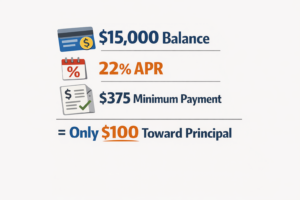
On a $15,000 balance at 22% APR, the monthly interest alone runs roughly $275. If your minimum payment is $375, only about $100 of that actually reduces your principal. The other 73% goes straight to the lender.
That math has gotten worse over time. Average APR on cards accruing interest hit 22.3% as of November 2025. Average rates hit 25.2% APR in 2024, the highest level recorded in nearly ten years. At those rates, many borrowers pay more in interest and fees each year than they reduce in principal.
Now consider what expense-cutting realistically generates. Skipping restaurant meals and canceling subscriptions might free up $100 to $200 per month for most households. On a $15,000 balance at 22%, that extra $100 to $200 gets absorbed almost entirely by the interest charges it was supposed to beat. You are running to stand still.
At $25,000 or more in balances, the gap widens further. Monthly interest can exceed $450 to $550. No realistic grocery budget or subscription audit closes that. People carrying high-interest credit card debt at that scale are not losing ground because of spending habits. They are losing ground because compounding interest outpaces anything a typical budget cut can generate.

What Does Debt Settlement Cost on $25,000?

On a $15,000 balance at 22% APR, the monthly interest alone runs roughly $275. If your minimum payment is $375, only about $100 of that actually reduces your principal. The other 73% goes straight to the lender.

That math has gotten worse over time. Average APR on cards accruing interest hit 22.3% as of November 2025. Average rates hit 25.2% APR in 2024, the highest level recorded in nearly ten years. At those rates, many borrowers pay more in interest and fees each year than they reduce in principal.

Infographic showing how most of a minimum payment goes to interest, not principal.Now consider what expense-cutting realistically generates. Skipping restaurant meals and canceling subscriptions might free up $100 to $200 per month for most households. On a $15,000 balance at 22%, that extra $100 to $200 gets absorbed almost entirely by the interest charges it was supposed to beat. You are running to stand still.

At $25,000 or more in balances, the gap widens further. Monthly interest can exceed $450 to $550. No realistic grocery budget or subscription audit closes that. People carrying high-interest credit card debt at that scale are not losing ground because of spending habits. They are losing ground because compounding interest outpaces anything a typical budget cut can generate.

Why This Advice Keeps Circulating

“Cut expenses and pay more” is not bad advice across the board. For someone with $3,000 in debt at 18%, it works. Behavioral change and a few months of focused payments can clear a balance at that scale.

But that guidance was written for a different profile. Banks and mainstream financial media serve a wide audience. They are not writing specifically for someone carrying $20,000 to $30,000 in high-interest debt who has already tightened their budget and is still losing ground each month. The advice was not designed for that situation, and applying it there often leads to months or years of effort with very little payoff progress.

Many cardholders with revolving balances find themselves stuck in ongoing debt, often paying more in interest and fees each year than they reduce from the principal. That’s not a budgeting failure—it’s a structural issue driven by high interest rates.

What Actually Moves the Needle on High-Interest Credit Card Debt

Three options can meaningfully address high-interest debt:

  • Consolidate high-interest credit card debt into a lower-rate loan
  • Balance transfer cards
  • Debt settlement

Each comes with trade-offs worth understanding before deciding.

Consolidate High-Interest Credit Card Debt
High interest rate icon

Debt consolidation combines multiple balances into a single loan at a lower interest rate. When it works, it reduces the monthly interest bleed and creates a fixed payoff timeline. The limitation is qualification. 

Lenders typically require good credit, and the rate reduction needs to be significant enough to justify the switch. If the new rate is only a few points lower than the existing cards, the savings are modest.

Balance Transfer Cards
Credit card transfer illustrationA 0% intro APR offer can provide a window of 12 to 21 months to pay down principal without interest accruing. These cards require solid credit to qualify, charge a transfer fee of typically 3% to 5%, and revert to a standard rate when the promotional period ends.

 For someone managing $8,000 to $10,000 and confident they can pay it down within the window, this can work. For someone carrying $20,000 to $30,000, it is rarely a complete solution.

Debt Settlement
Handshake symbolizing successful agreementFor people with significant unsecured balances who cannot realistically pay in full, debt settlement negotiates the principal down directly. This is the most structural way to reduce what you owe and get out of the minimum payment cycle.

CreditAssociates negotiates directly with creditors on enrolled accounts and has helped clients resolve debt in 24 to 48 months. The program is designed for people carrying $10,000 or more in unsecured debt who are not making meaningful progress through payments alone.

If your balance is over $25,000 and expense-cutting has not worked, a free consultation with CreditAssociates takes about 15 minutes.

Signs That Your High-Interest Debt Has Passed the Tipping Point

Standard repayment strategies have stopped working when:

  • Minimum payments are mostly interest, with little principal reduction month over month
  • Balance stays flat or grows despite consistent payments
  • You have already cut obvious expenses and still cannot build payoff momentum
  • You have been carrying high-interest credit card debt for more than a year with no meaningful progress
  • You are using credit cards to cover basic expenses because cash flow is too tight after payments

If most of those sound accurate, the problem is not discipline. It is that compounding interest at a high APR outpaces what most realistic payment amounts can accomplish.

Is Debt Settlement Right for Your Situation?

Debt settlement is not the right fit for everyone. It is specifically designed for people carrying unsecured debt at a level that makes full repayment within a reasonable timeline unrealistic.

It tends to be the right conversation if you are:

  • Carrying $10,000 or more in unsecured credit card debt
  • Struggling to make minimum payments or unable to make meaningful progress on the balance
  • Already tried budgeting or consolidation without results

Understanding the pros and cons of debt settlement before enrolling is worth the time. It is also worth knowing which debts qualify. Debt settlement applies to unsecured debt like credit cards, personal loans, and medical bills. 

Secured debts like mortgages and auto loans are not eligible. A full breakdown of what debts are eligible can help you evaluate whether your specific accounts qualify before making a call.

CreditAssociates clients enroll an average of $25,000 in debt and receive an approximate 50% reduction on what they owe, before service fees. Program timelines typically run 24 to 48 months.

If those conditions sound familiar, it may be worth a free 15-minute conversation to see what your options actually look like. Schedule a free consultation with CreditAssociates.

A Realistic Path Forward on High-Interest Credit Cards

If you are not yet ready to make a call, these three steps reveal exactly where you stand:

1) Stop adding to the balance where possible. New charges at 22%+ APR compound the problem. Even pausing credit card use while evaluating options prevents the balance from growing.

2) Calculate your actual monthly interest cost, not just the minimum due. Divide your APR by 12 and multiply it by your balance. On a $20,000 balance at 22%, that is roughly $367 per month in interest alone. Knowing that number makes the math concrete.

3) Evaluate whether DIY methods are realistic. If your monthly interest charge is higher than what you can realistically add to your payment each month, standard repayment is not a viable path to getting out. That is the signal to look at structured options.

Calculating expenses with documents and calculatorThere Is a Way Out of High-Interest Credit Card Debt

Every month of delay costs real money. On a $25,000 balance at 22% APR, each month that passes without addressing the principal adds roughly $458 in interest charges. That number grows as the balance does.

People who cannot get rid of high-interest credit cards through budgeting alone are not failing at personal finance. They are trying to solve a math problem with the wrong tool. Compounding interest at 20% to 25% is not beaten by cutting $150 per month from a grocery budget. It requires changing the terms of the debt itself.

CreditAssociates offers a free consultation to review your specific situation, no commitment required. If debt settlement is not the right fit, we will tell you that, too.

Ready to stop watching interest charges eat your payments? Get a Free Debt Consultation — takes about 15 minutes.

Sidebar - Blog

  • This field is for validation purposes and should be left unchanged.
  • Get Stated With A Free Consultation

  • *By clicking “Free Consultation,” you agree the phone number and email address provided may be used for contact by CreditAssociates, LLC (including auto-dial/auto-select and prerecorded/artificial voice/AI voicebot calls, as well as text/SMS messages). Msg. and data rates apply, your consent to contact/marketing is not required for purchase. Msg frequency varies. You may opt out at any time. You also consent to a soft credit inquiry solely to determine if your debt qualifies for our program. You agree to our Privacy Policy and Terms , including while calls are monitored and recorded by a virtual assistant and third-party AI platform, how we collect, process, and share information, and the agreement to arbitrate disputes.

  • This field is hidden when viewing the form
  • This field is hidden when viewing the form
  • This field is hidden when viewing the form
  • This field is hidden when viewing the form
  • This field is hidden when viewing the form